
NCHU Faculty–Student Team Develops an Endophyte-Based Biostimulant to Boost Carbon Sequestration and Stress Tolerance, Winning First Prize at the 7th 2025 Green Idea International Invention and Design Competition (2025.08)
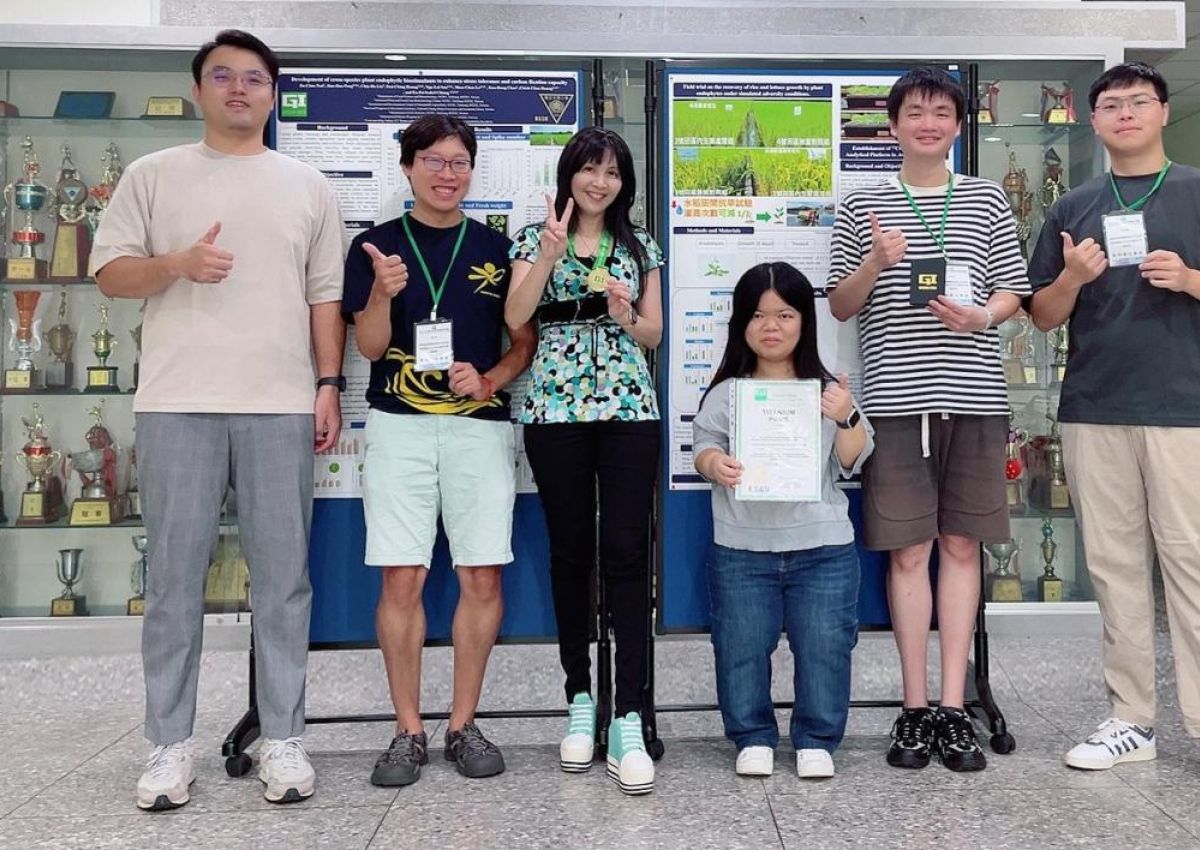
A faculty–student team from National Chung Hsing University (NCHU) won the top honor—the Titanium Gold First Prize (First Prize)—at the 7th 2025 Green Idea International Invention and Design Competition with its project titled “Developing an Endophyte-Based Biostimulant to Enhance Cross-Species Plant Stress Tolerance and Carbon Sequestration Capacity.” Standing out among numerous entries, the NCHU team demonstrated strong innovation and interdisciplinary integration. Notably, the team has won the highest honor in this international competition for two consecutive years with different R&D achievements.
This year’s competition drew 198 entries from Taiwan, Indonesia, Cambodia, Myanmar, Malaysia, Vietnam, Thailand, South Korea, and Singapore, including 18 teams in the Design category, 164 teams in the Invention–Social category, and 16 teams in the Youth category, making the competition highly competitive.
The award-winning team competed in the Invention–Social category under the joint supervision of Director En-Pei Isabel Chiang (Department of Food Science and Biotechnology) and Dean Chieh-Chen Huang (College of Life Sciences). Team members included master’s student Chia-Chen Tsai (Department of Food Science and Biotechnology), Ph.D. student Chien-Hao Peng (Ph.D. Program in Microbial Genomics), master’s students Chia-Ho Liu and Tsai-Ching Huang (Department of Life Sciences), and postdoctoral researchers Shou-Jen Lo (Department of Life Sciences) and Ya-Li Su (Department of Food Science and Biotechnology).
The team’s presenter, first-year master’s student Chia-Chen Tsai, has faced many challenges throughout her studies due to a congenital disadvantage in height, which affected certain opportunities for development. Nevertheless, she has consistently maintained a positive and proactive attitude. Director Chiang noted that Tsai’s dedication and hard work in research were deeply impressive, and she was especially pleased and delighted to see Tsai’s achievements recognized. She also emphasized that the team’s consecutive wins were made possible by the members’ strong collaboration and excellent teamwork.
Tsai shared that she was deeply grateful to Director Chiang for accepting her as a graduate student and offering a forward-looking and engaging research topic. She also expressed special thanks to senior Ph.D. student Chien-Hao Peng for his careful guidance. In addition to proactively sharing valuable experience before the competition, he assisted in answering judges’ questions on site, giving her greater confidence in handling the competition.
Peng previously represented the team in 2024 and won the same competition’s top Titanium Gold Award with the project “Engineering a Reverse TCA Cycle Gene System to Construct a Carbon-Fixing E. coli Capable of CO₂ Uptake and Carbon-Flux Regulation.” He said he felt honored to move from being last year’s presenter to supporting a junior teammate this year to continue the team’s success. Beyond the research outcomes, he also saw growth and progress for himself and the team in interdisciplinary collaboration, knowledge transfer, and outreach of成果, highlighting NCHU’s solid and comprehensive efforts in talent cultivation. He added that, in addition to his doctoral dissertation topic, participating in interdisciplinary collaboration and personally witnessing research move from the laboratory to practical applications and public presentation has been an invaluable learning experience.
The award-winning technology originated from endophytic strains with biostimulant functions screened from the plant “Pei-di-mao.” The strains have been successfully applied to multiple crops, effectively enhancing plant tolerance to environmental stresses such as drought, nutrient deficiency, and high temperature, while also improving carbon fixation efficiency and demonstrating significant carbon sequestration potential. The team also used the model plant Arabidopsis as an experimental system to further investigate how the endophytes and their metabolites influence carbon flux and carbon metabolism in plants, establishing key research foundations for understanding the underlying mechanisms.
To respond to the evolving global carbon credit system and the transition toward sustainable agriculture, the team has recently collaborated with Academician Wen-Hsiung Li of Academia Sinica and Professor Kuo-Jung Chao of the International Master Program of Agriculture at NCHU to 추진 the forward-looking “Green Carbon Technology Integration Project.” Centered on an endophyte-based biostimulant and a cellulolytic enzyme complex, the project aims to build a “Green Carbon Sink Enhancement Circulation System.” By creating a positive feedback loop that promotes plant growth and carbon capture and storage, each cycle can increase carbon sink capacity, ultimately storing carbon in natural sinks and realizing “technology-driven ecological carbon sink enhancement.” In addition, field trials on first-crop rice showed a 38% reduction in carbon emissions during cultivation, helping low-carbon grain producers improve product competitiveness.
The team pointed out that, compared with conventional agriculture that relies on chemical inputs for short-term yield gains—often at the expense of long-term soil and environmental health—this research demonstrates the feasibility of using environmentally friendly biological strategies to achieve both yield improvement and climate adaptation. As the technology continues to mature, it is expected to be extended to more staple and cash crops and further expanded into industries such as carbon management, biotechnology applications, and environmental engineering, with substantial development potential and practical value.
Article source: https://canr.nchu.edu.tw/web/result/detail.php?lang=zh_tw&cid=3&id=1351