
2025-12-01
2025 International Conference on Agricultural Biotechnology
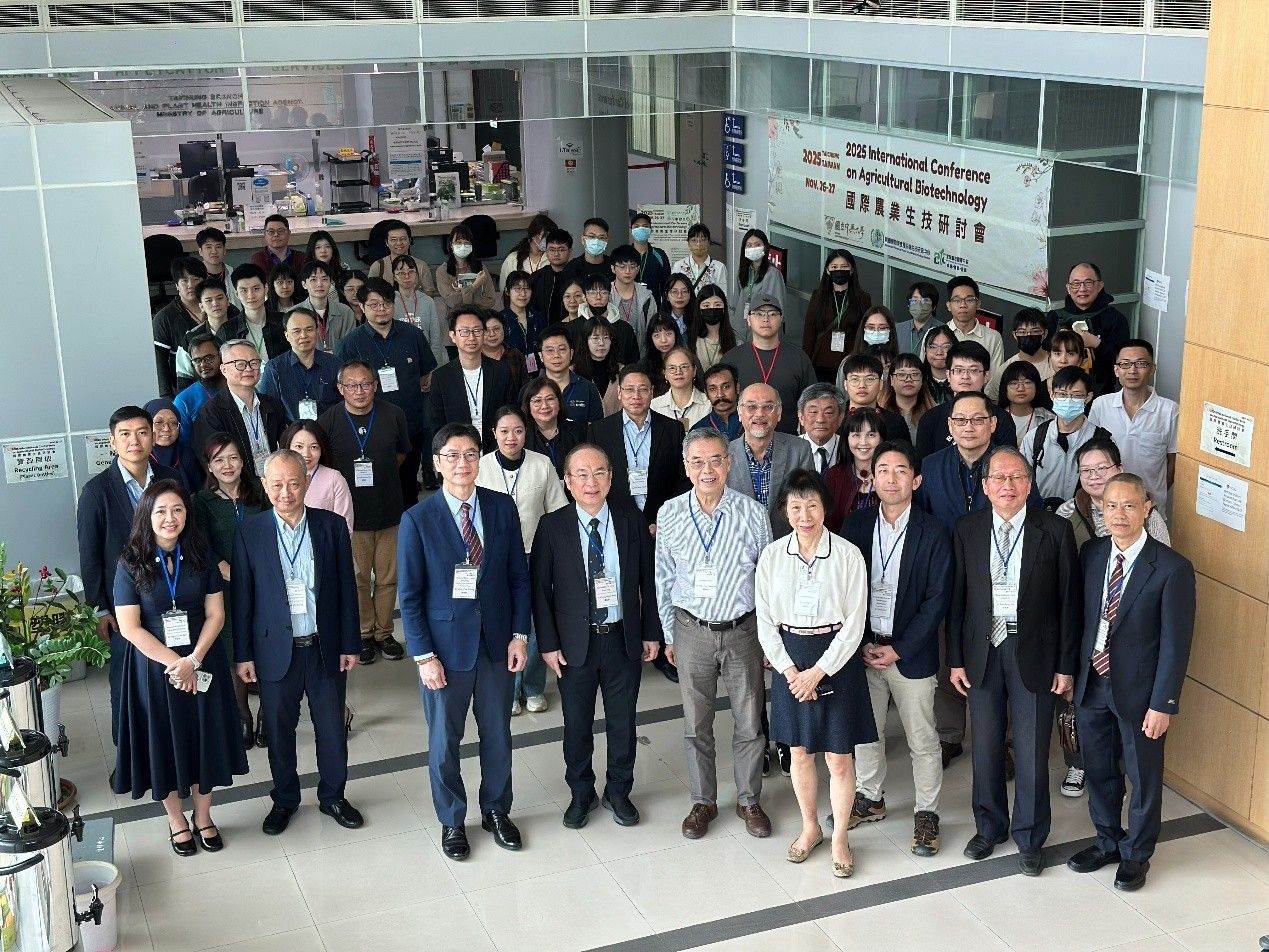
Co-hosted by the Advanced Plant and Food Crop Biotechnology Center, led by Academicians Shyi-Dong Yeh (VAAS–NCHU ASTIC) and Chang-Hsien Yang, and the Biotechnology Center directed by Ming-Hon Hou, the 2025 International Conference on Agricultural Biotechnology was grandly held from November 26 to 28, 2025, at the Conference Hall (1F), Bureau of Animal and Plant Health Inspection and Quarantine Building, National Chung Hsing University.
In addition to inviting leading scientists from Taiwan, the conference brought together top experts from Japan’s National Agriculture and Food Research Organization (NARO) and the International Rice Research Institute (IRRI) of the Philippines, as well as specialists from Vietnam Academy of Agricultural Sciences (VAAS), the Cuu Long Delta Rice Research Institute (CLRRI), and Vietnam National University of Agriculture (VNUA). Through this international platform, the conference strengthened collaborations among Japan, the Philippines, Vietnam, and Taiwan, and laid a more solid foundation for current and future biotechnology research programs on plants and food crops.
The program covered a wide range of frontier topics, including climate-resilient crop breeding, precision genome editing, and viral disease management. Featuring a strong lineup of distinguished speakers, the conference particularly invited Academician Tuan-hua David Ho of Academia Sinica as a keynote speaker. His talks addressed innovative technologies for rice gene screening and the “mechanistic basis of rice root growth under different water conditions,” providing crucial scientific insights for crop adaptation strategies under climate change.
In response to global climate challenges, Dr. Yusaku Uga from NARO presented “Challenges in breeding climate-resilient rice root systems,” offering an in-depth discussion on how root ideotype breeding can be used to develop new rice varieties capable of withstanding extreme conditions such as drought.
In the field of crop disease diagnosis, Dr. Gilda Jonson from IRRI drew on extensive field survey experience in the Philippines to analyze the complex disease issues associated with “co-infection of rice viruses and phytoplasmas,” and highlighted innovative applications of precision diagnostic technologies.
In addition, a delegation from VAAS led by Dr. Bui Quang Dang shared major research achievements tailored to local needs in Vietnam, including the development of the Phalaenopsis orchid industry, management of papaya ringspot virus, and molecular breeding for salt tolerance in rice.
Meanwhile, multiple scholars from National Chung Hsing University comprehensively showcased Taiwan’s cutting-edge R&D capacity in areas such as genome-editing technologies, plant virus vaccine development, rice disease management, photosynthesis, and metabolic engineering. These achievements not only reflect the University’s long-term commitment to both fundamental and applied agricultural biotechnology research, but also underscore Taiwan’s central role in the Asia-Pacific agricultural technology innovation ecosystem.
Over the three days, the conference delivered an intensive and diverse agenda. Beyond fundamental research topics—such as rice root-system breeding, photosynthetic systems, metabolic engineering, and plant virus control—the program further emphasized application-oriented themes including rice gene screening, diagnostics for virus–phytoplasma co-infection, molecular breeding technologies, and biological control. By balancing theoretical depth with practical value, the conference not only served as a vital platform for academic exchange but also deepened international cooperation to jointly address global food security and climate change challenges—injecting new momentum into agricultural innovation across the Asia-Pacific region and opening a new chapter toward sustainable agriculture.
Article source: https://www2.nchu.edu.tw/news-detail/id/60881