
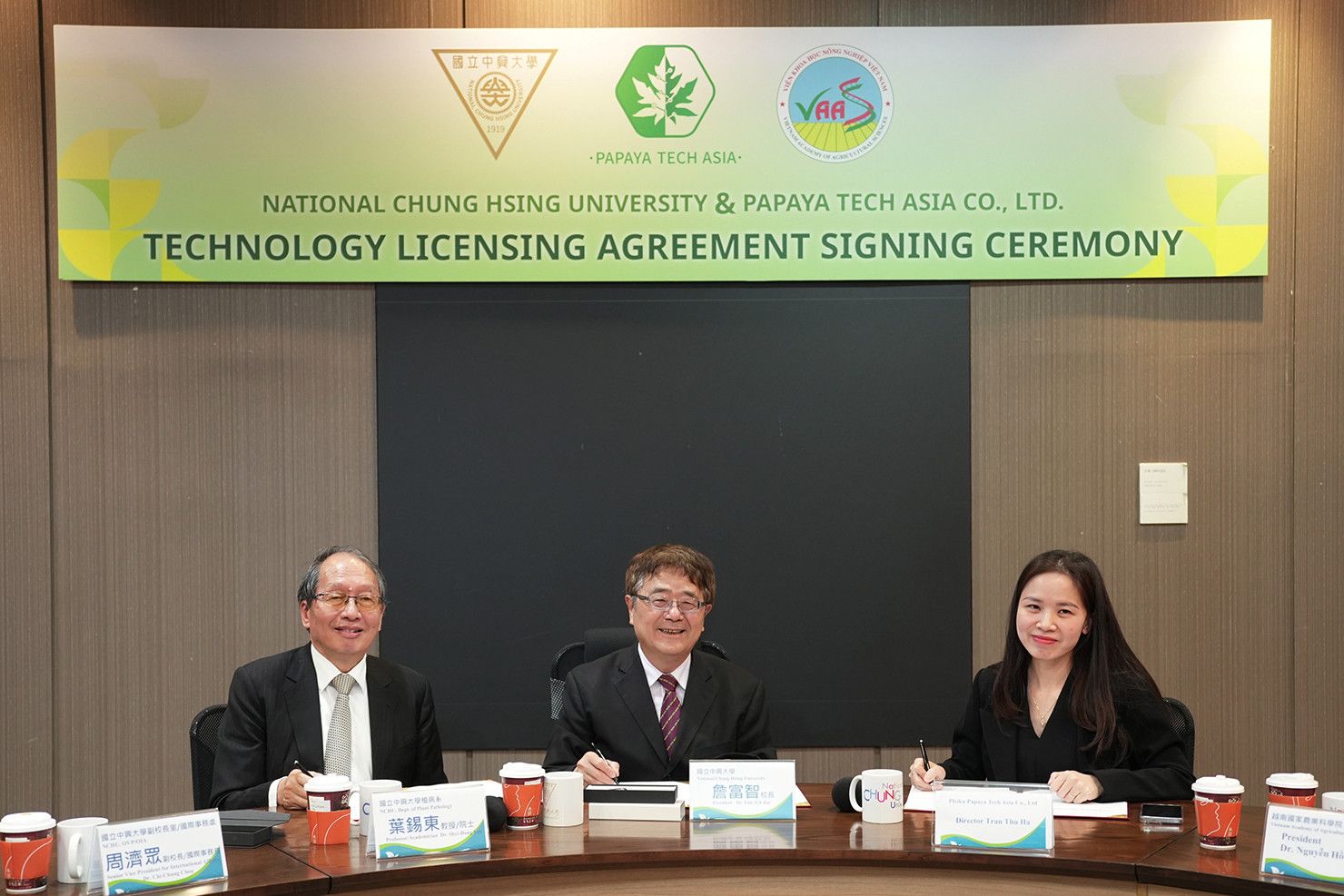
On December 1, Academician Shyi-Dong Yeh of National Chung Hsing University (NCHU) signed a technology licensing agreement with Vietnam’s Papaya Tech Asia Co., Ltd. The signing ceremony was witnessed by President Fuh-Jyh Jan, together with a special guest, Dr. Nguyễn Hồng Sơn, President of the Vietnam Academy of Agricultural Sciences (VAAS), a long-term partner of NCHU. The event marked a new milestone in Taiwan–Vietnam cooperation in agricultural science and technology.
NCHU is internationally recognized for its world-leading research in tropical and subtropical agriculture and has long served as a key base for Taiwan’s international agricultural technology assistance. In recent years, the University has further strengthened its strategic engagement in Southeast and South Asia, promoting international collaboration and technology export in agricultural biotechnology, with Vietnam as its most important strategic partner.
With support from Taiwan’s Ministry of Science and Technology, NCHU and VAAS jointly established the VAAS–NCHU Agricultural Science and Technology Innovation Center (VAAS–NCHU ASTIC) in 2017, led by Academician Shyi-Dong Yeh, an internationally renowned expert in plant virology and tropical fruit crops. The Center has successfully integrated NCHU’s strengths in biotechnology, plant protection, and food processing, while working closely with 19 national-level research institutes under VAAS and multiple agricultural universities in Vietnam. These collaborations have facilitated the localization and implementation of a range of technologies in Vietnam, including biofertilizers, biopesticides, and the management of soil-borne and viral diseases—helping build integrated industry chains and markets and opening a new chapter in Taiwan–Vietnam agricultural technology cooperation.
Over the years, NCHU’s collaboration with Vietnam has generated substantial outcomes. In the passion fruit sector, NCHU assisted NAFOODS in establishing Asia’s largest virus-free grafted passion fruit seedling propagation facility and co-founded the “Nafoods–NCHU Plant Virus Certification Center,” which has become a key hub for modern plant virus diagnostics in Vietnam. In the papaya industry, Academician Yeh’s team worked with VAAS to address large-scale cultivation challenges in Vietnam caused by papaya ringspot virus (PRSV), conducting trials across northern, central, and southern Vietnam with excellent results. NCHU has also planned, together with Vietnam’s Ministry of Agriculture, to promote a 250-hectare commercial papaya demonstration area, positioning Vietnam to become a major production hub for high-quality papaya in Asia.
The technology licensing collaboration between NCHU and Papaya Tech Asia Co., Ltd. represents an important extension built upon this long-standing foundation. Leveraging NCHU’s mature capabilities in tissue culture, vaccine-based protection, disease management, and automated cultivation technologies, the partnership will help Vietnam establish a modern papaya industry system and comprehensive standard operating procedures for field management. These practices will be progressively promoted through demonstration sites across Vietnam’s provinces, with the goal of building an internationally competitive papaya brand.
Dr. Nguyễn Hồng Sơn, President of VAAS, stated that NCHU is among Vietnam’s most trusted research partners. He noted that the achievements advanced jointly over many years have tangibly improved the structure and quality of Vietnam’s fruit-tree industry and laid a new foundation for sustainable agricultural development. He expressed hope that this licensing agreement will lead to deeper collaborations and enable Taiwan’s successful experience to be scaled nationwide across Vietnam.
President Fuh-Jyh Jan emphasized that the collaboration represents not only a technology transfer, but also a shared vision for Taiwan and Vietnam to advance agricultural innovation, biotechnology industrialization, and international market development together. Looking ahead, NCHU will continue to leverage its R&D strengths in plant protection, biotechnology, and agricultural engineering to deepen linkages with VAAS and Vietnam’s industry partners, promote more cross-border collaborative programs, and contribute Taiwan’s agricultural technology capabilities to the international community—working toward a more resilient future for global agriculture.