
2026-02-11
National Chung Hsing University (NCHU) Enters the ESI Top 1% Worldwide in 11 Subjects, Ranking Fourth Among Taiwan’s National Universities
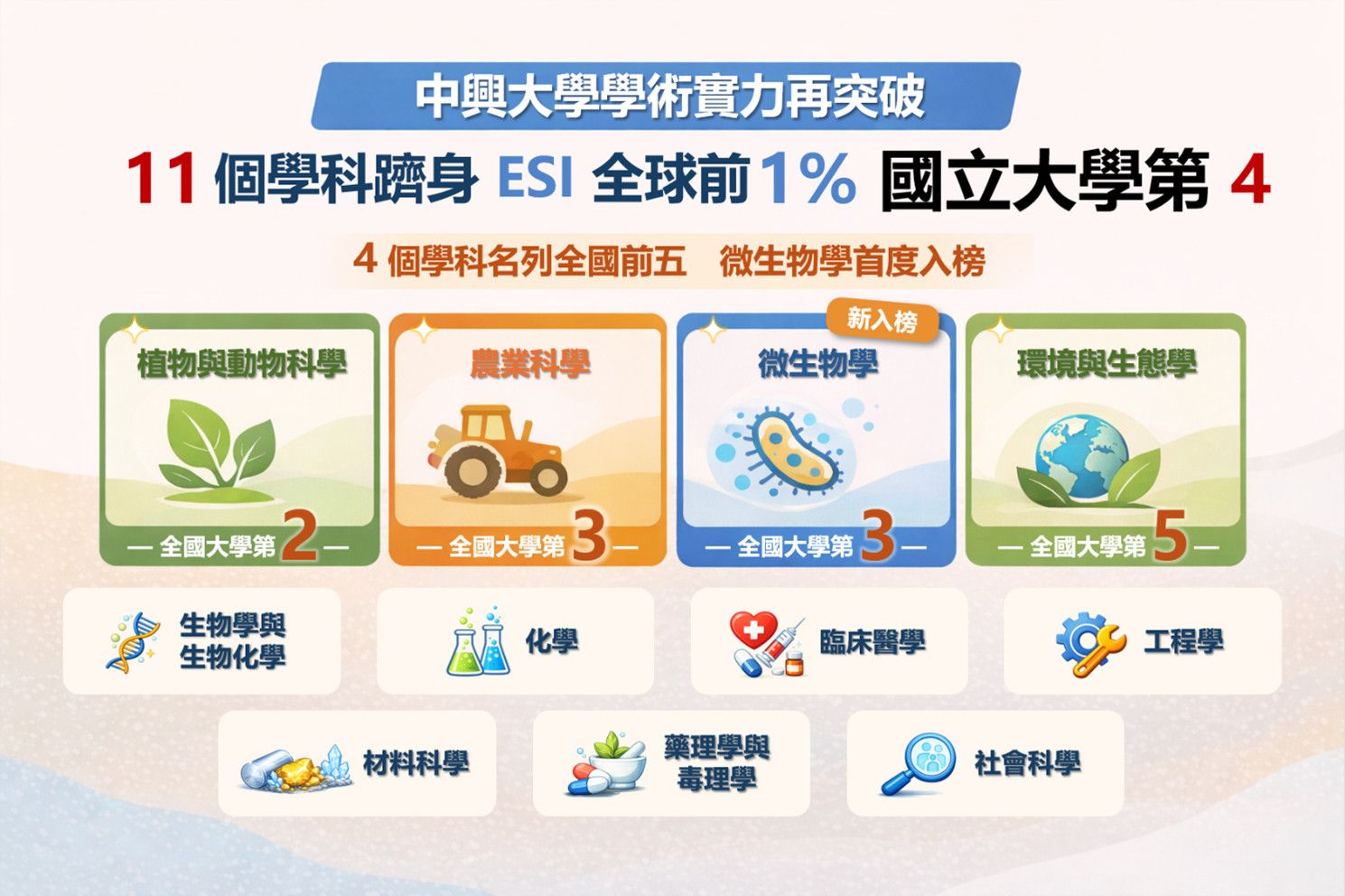
NCHU has achieved another major milestone in academic performance, with its international impact continuing to rise. According to the latest Essential Science Indicators (ESI) results released on January 8, 2026, NCHU has added “Microbiology” to the ESI top 1% worldwide, bringing the University’s total number of top 1% subjects to 11 and placing NCHU fourth among Taiwan’s national universities. This accomplishment highlights NCHU’s balanced development and outstanding performance across agriculture and life sciences, science and engineering, medicine, and the humanities and social sciences.
The newly ranked subject, Microbiology, is positioned third among universities nationwide. Together with NCHU’s established strengths, this further reinforces the University’s research depth and capacity in life sciences and medicine. NCHU noted that Microbiology’s entry into the ESI top 1% aligns closely with the University’s recent strategic initiatives in precision health, biomedical technology, and interdisciplinary biotechnology research. The result demonstrates how sustained research investment is being translated into tangible and measurable international academic influence, reflecting the outcomes of long-term efforts.
Eleven Subjects in the ESI Top 1% Showcase Comprehensive Strength Across Disciplines
To date, NCHU has 11 subjects ranked in the ESI top 1% worldwide, covering a broad spectrum of research areas spanning natural sciences, engineering and technology, life sciences and medicine, and the humanities and social sciences. This reflects a multi-core development strategy characteristic of a comprehensive research university. The 11 ESI top 1% subjects at NCHU are:
• Agricultural Sciences (No. 3 nationwide)
• Biology & Biochemistry
• Chemistry
• Clinical Medicine
• Engineering
• Environment/Ecology (No. 5 nationwide)
• Materials Science
• Microbiology (No. 3 nationwide; newly added)
• Pharmacology & Toxicology
• Plant & Animal Science (No. 2 nationwide)
• Social Sciences
This achievement not only underscores NCHU’s solid foundation and long-term commitment to agriculture and life sciences, but also demonstrates simultaneous growth in science and engineering, medicine, and the humanities and social sciences—further shaping NCHU into a comprehensive research university with multiple strengths, interdisciplinary integration, and balanced development.
Institutional Investment Delivers Key Benefits and Builds a Sustainable Research Ecosystem
NCHU emphasized that continued breakthroughs in academic performance are not short-term outcomes or isolated accomplishments, but rather the result of long-term, forward-looking institutional planning and sustained resource investment. In recent years, the University has actively secured competitive research funding from the Ministry of Education, the National Science and Technology Council, and other government agencies, while strengthening internal research support mechanisms, including:
• Global talent recruitment and retention: attracting Yushan Fellows and Yushan Young Fellows to build internationally competitive research teams
• Research incentive and subsidy programs: encouraging high-quality publications and cross-national, cross-disciplinary collaboration
• Upgrading key facilities and research environments: establishing shared core facilities to enhance research efficiency and depth
• Interdisciplinary and international collaboration: linking with leading universities and research institutions worldwide to strengthen global competitiveness
About ESI: Measuring Global Research Strength Through Long-Term Citation Impact
ESI is a widely used international indicator for evaluating research impact. Based on high-quality journal articles indexed in the Web of Science Core Collection, ESI uses an approximately 11-year rolling dataset and is updated every two months. It assesses long-term research performance of researchers, institutions, countries, and journals across 22 subject areas using citation counts as the primary metric.
The January 2026 ESI results cover research outputs from January 2015 to October 2025, with document types limited to Articles and Reviews. Publication counts are drawn from SCIE and SSCI journals, while citation counts incorporate citations from SCIE, SSCI, and AHCI, providing a comprehensive reflection of universities’ long-term research output quality and academic influence.
Moving Forward Toward a World-Class Research University
NCHU noted that having 11 subjects ranked in the ESI top 1% worldwide is part of a continuous process of improvement. Building on its existing research foundations, the University will further consolidate and expand its areas of strength, steadily advancing academic capacity, societal impact, and global visibility as it moves toward the goal of becoming a world-class leading university.
Article source: https://www2.nchu.edu.tw/news-detail/id/61268