
2025-07-03
National Chung Hsing University Yushan Fellow Wilhelm Gruissem: Planting the Seeds of Sustainability in Taiwan—Advancing Cutting-Edge Food Technology to Improve the Health of the World’s Poor
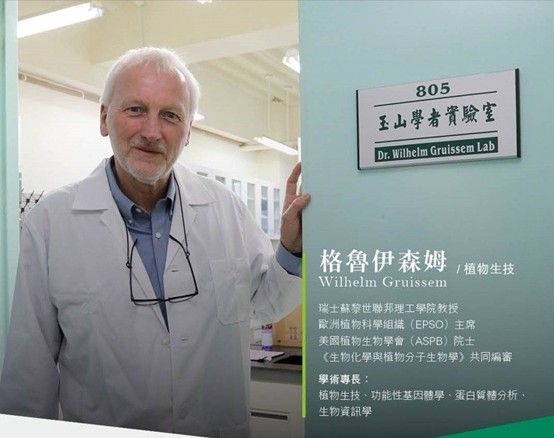
The Ministry of Education (MOE) launched the “MOE Program for Recruiting International Top Talent to Universities and Colleges” in Academic Year 2018 (commonly known as the Yushan Fellow Program) to help universities recruit world-class international talent and thereby enhance Taiwan’s competitiveness and global influence in higher education. In this bimonthly issue of Evaluation, we invited Yushan Fellow Professor Wilhelm Gruissem of National Chung Hsing University (NCHU) to share his experiences of exchange and collaboration with NCHU—how these efforts have helped position Taiwan as a key hub for developing cutting-edge global food technologies—and to offer his perspectives and recommendations on nurturing talent in the field of plant biotechnology.
Professor Wilhelm Gruissem is affiliated with the Institute of Molecular Plant Biology at the Swiss Federal Institute of Technology in Zurich (ETH Zurich), Switzerland. He is a Fellow of the American Association for the Advancement of Science (AAAS) and the American Society of Plant Biologists (ASPB). He has served as Editor-in-Chief of Plant Molecular Biology and as co-editor of the scholarly reference work Biochemistry and Molecular Biology of Plants. Professor Gruissem has made outstanding contributions to plant biotechnology, including genetic improvement of rice and cassava to enhance their nutritional value, improve the health of impoverished populations, and advance sustainable development. Since 2018, he has been appointed as a Yushan Fellow, serving as Chair Professor at NCHU’s Center for Biotechnology Development and as a member of the Advanced Plant and Food Crop Biotechnology Research Center.
A: I have to start from my high school years. My parents wanted me to become a physician—they very much hoped I could help people achieve better health. But I wasn’t interested in becoming a doctor. I wanted to do research and become a scientist. In high school, I had an excellent biology teacher who sparked my interest in biology. So when I became a student at the University of Bonn in Germany, I began studying biology and chemistry. That was quite a challenge because they are two parallel disciplines, so I had to work very hard to do well in both at the same time. Later, I obtained my diploma and my Ph.D. After completing my doctorate, I worked in Germany for two years as a postdoctoral researcher on a very interesting project, and then I had the opportunity to go to the United States and join an outstanding laboratory. That lab collaborated closely with another group whose principal investigator later became a Nobel laureate, so it was an extremely motivating environment, and my research progressed very smoothly.
I later taught at the University of California, Berkeley, and served as Chair of the Department of Plant and Microbial Biology. I spent nearly 18 years in the United States, and my research was very successful. In 2000, I was recruited by the President of ETH Zurich, so I returned to Europe to teach at the Institute of Molecular Plant Biology. In 2017, I was invited to Taiwan to present my research at a biotechnology conference. During the meeting, I mentioned that we needed to test rice varieties, and NCHU’s Vice President for Academic Affairs, Professor Chang-Hsien Yang—whom I already knew from Berkeley—along with many scholars at the meeting, invited me to come to Taiwan. That was the beginning of my path here. Since 2018, I have served as a Yushan Fellow, spending half of each year in Taiwan. I must say, I am truly very happy to be here.
Q: How is your research related to sustainable development? In your view, what role can Taiwan play in addressing the challenges of global climate change and the needs for food and health?
A: Twenty-five years ago, when I moved to ETH Zurich, I became a professor of biotechnology and conducted a great deal of basic research, but we also began working on rice and cassava. At that time, I faced a choice: I could study any crop, but if I focused on rice and cassava, I could contribute to sustainable development—because these two crops feed a very large proportion of the world’s population and are primarily grown by smallholder farmers. Moreover, many poor people cannot afford other sources of nutrition beyond these staple foods. If we can make these crops more nutritious, we can improve the health of poor populations and also help farmers.
Take rice as an example. It is a staple food for many people and is rich in carbohydrates, but its nutritional value is not high. If someone eats rice at every meal simply to feel full, they may obtain calories but not good nutrition, because rice lacks essential micronutrients such as iron, zinc, and vitamins. These cannot be added to rice through conventional breeding, because rice cultivation offers no genetic basis that can be used to breed varieties with increased micronutrient content. Therefore, we decided that genetic modification was the only way to achieve this goal. In rice, we have been successful: we now have rice varieties with increased iron and zinc, and we have also increased the levels of vitamin B1 and vitamin A. We can combine these different micronutrients to produce multiple nutrient-enriched rice varieties, and we have shown that these micronutrients can be absorbed by the human body. Our rice varieties have been tested for several years and continue to be tested to ensure that the traits we established through genetic modification are stable, do not affect yield, and do not harm the environment. In the next stage, we will further explore increasing iron in rice not through genetic modification but through genome editing.
In Taiwan, cassava is mainly used as the starch source for tapioca pearls in bubble tea, but in Africa and many Southeast Asian countries it is a critical staple food. Our initial goal was primarily to make cassava resistant to viruses. If we can help improve crop resistance to these viruses, farmers will increase yields and income, and the overall economy will also benefit. These more virus-resistant cassava varieties have already been planted. However, achieving sufficient yields remains a major challenge in Africa. Smallholder farmers there have no money to buy fertilizer, and they rely only on rainfall; yields are only 4 to 8 tons per acre. About ten years ago, the Bill & Melinda Gates Foundation asked us whether it would be possible to increase cassava yield under limited resources, thereby helping address food shortages in Africa. This is the direction we are working toward.
Taiwan plays an important role in promoting sustainable development through food technology. Using cassava as an example, Taiwan not only has a suitable climate, experimental farms, and strong research manpower, but also an additional advantage: Taiwan does not face the severe viral pressures seen in Africa. At present, the work conducted on NCHU’s experimental farms focuses on early-stage testing; based on the research results, the next step is to produce improved cassava varieties in Africa. Collaborative partners such as the International Institute of Tropical Agriculture (IITA) and the Nigerian National Root Crops Research Institute (NRCRI) must continue the work we have carried out in Taiwan. For rice, countries such as the Philippines and Bangladesh are also interested in breeding collaborations. Imagine if an average person could obtain about 80% of their required iron intake from a single bowl of rice—this would have major impacts on livelihoods, health, and the economy. This reflects Taiwan’s significant contribution through the improvement of rice and cassava varieties and through efforts to address food shortages and health challenges in poorer countries.
A: The most important meaning of implementing this project in Taiwan is to demonstrate that varieties developed in the laboratory and greenhouse can actually grow in the field. NCHU provides extremely important experimental farmland as the final site for real-world field testing, and we also conduct research there. I already had my own research team, and after coming to NCHU, I hired postdoctoral researchers, research assistants, and an administrative assistant. We have about 10 to 12 people working on the farm, conducting extensive early-stage preparations, including field management. It is a very dedicated and excellent team. I have an international postdoctoral researcher from India, and I believe this project is important for him personally and for his country. He is very excited to be able to participate.
At the same time, this research team is also offering a new course on plant biotechnology and synthetic biology. Initially, I designed it as a master’s-level course, but some students seemed hesitant—they felt the course was too difficult and worried they would not earn good grades, so they were afraid to enroll. However, if students and team members aspire to develop internationally in this field, they can benefit greatly from the research and hands-on work experience offered by this project.
We also encountered a challenge in the cassava project: importing plant materials into Taiwan is very difficult. At the beginning, even though everything we imported—including packaging and containers—was sterile, the authorities still wanted to confirm that bringing these materials into the field would truly be safe. So in the first year, they tested our cassava, and of course everything was normal. After that, our collaboration proceeded very smoothly.
A: I have a deep connection to the Yushan Fellow Program. Since 2000, I have participated in many evaluation activities at Academia Sinica, and later I served as a foreign advisory committee member for Taiwan’s National Science Council (now the Ministry of Science and Technology), coming to Taiwan every year to attend meetings with government agencies. One meeting focused on Taiwan’s scientific development. We discussed how Taiwan could become stronger in science and gain greater international recognition. At that time, the advisory committee recommended to the Ministry of Education that Taiwan should establish an institutional mechanism to enable more top international scientists to come to Taiwan and interact with Taiwanese scientists, thereby enhancing Taiwan’s scientific standing and international visibility. I am very glad that this recommendation was adopted and ultimately contributed to the establishment of the Yushan Fellow Program.
The Yushan Fellow Program helps Taiwan recruit top international talent and also promotes greater internationalization of universities. The current trend is that many international students at universities come from Asia, and in the future we also hope to see more students from Europe and North America come to Taiwan to study. I have also seen improvements in administrative procedures and language support as international scholars join universities. I am grateful to President Fu-Chih Chan of NCHU for paying attention to how the university can further improve internationalization. I appreciate that he listens to my suggestions, enabling many initiatives to move forward smoothly.
I believe this is a very important program, and personally I hope Taiwan will continue to do this. In addition, Taiwan should actively invite top international scientists to serve as Yushan Fellows. Through their personal networks and reputations, this will help recruit more outstanding scholars and amplify the program’s impact. In terms of mechanisms, there are currently limits on the appointment period; if the duration could be extended or made more flexible, it would be helpful for the program’s long-term effects.
Q: Amid today’s rush toward ICT and AI, how can we attract and cultivate talent in plant biotechnology? What advice would you give to young Taiwanese students who pursue excellence?
A: AI is indeed important, and many of the things we do are based on AI, so we also take advantage of that in our own research. But I think students should understand one thing: if human beings have nothing to eat, the existence of AI loses its meaning. Just as I decided to work on rice and cassava because I wanted to help farmers and poor populations, I believe students must also recognize that we have a responsibility to society. To ensure that agriculture can continue to exist as global temperatures rise by 2 to 3 degrees, we must make crops more resilient—this is crucial—and AI alone cannot feed the world.
Another key point is that choosing a field depends on early learning. When my own children were in kindergarten, teachers often asked my wife and me, “Could you do some simple experiments with the children so they can understand what biology is?” My wife is also a scientist, so we would go to schools and do experiments with the children. We also visited high schools and spent several class sessions talking with students about what genetic modification means and why it is important. I believe early inspiration is absolutely critical, because if we do not do this, students will not develop interest in these fields.
As a teacher, my advice to Taiwanese students is: if you want to succeed, you must be willing to take on challenges and learn without fear of difficulty. You also need the right mindset—do not choose easy courses simply to get good grades; instead, dare to try and push beyond your limits.
Finally, I would like to share that life is full of wonderful vitality. Especially when you work in biology, it feels as though every day opens a new page—every day brings unexpected and novel discoveries. It is truly exciting. This not only helps keep the brain active, but is also a continuous learning process. You must feel passionate about what you are doing, you must have ambition and motivation to learn, and you must cherish the opportunity to study the “essence of life.” Beyond that, work hard and study hard. I agree that sometimes luck is important, but without hard work and learning, it is impossible to seize fortunate opportunities.
Article source: https://udn.com/news/story/6885/8845266